

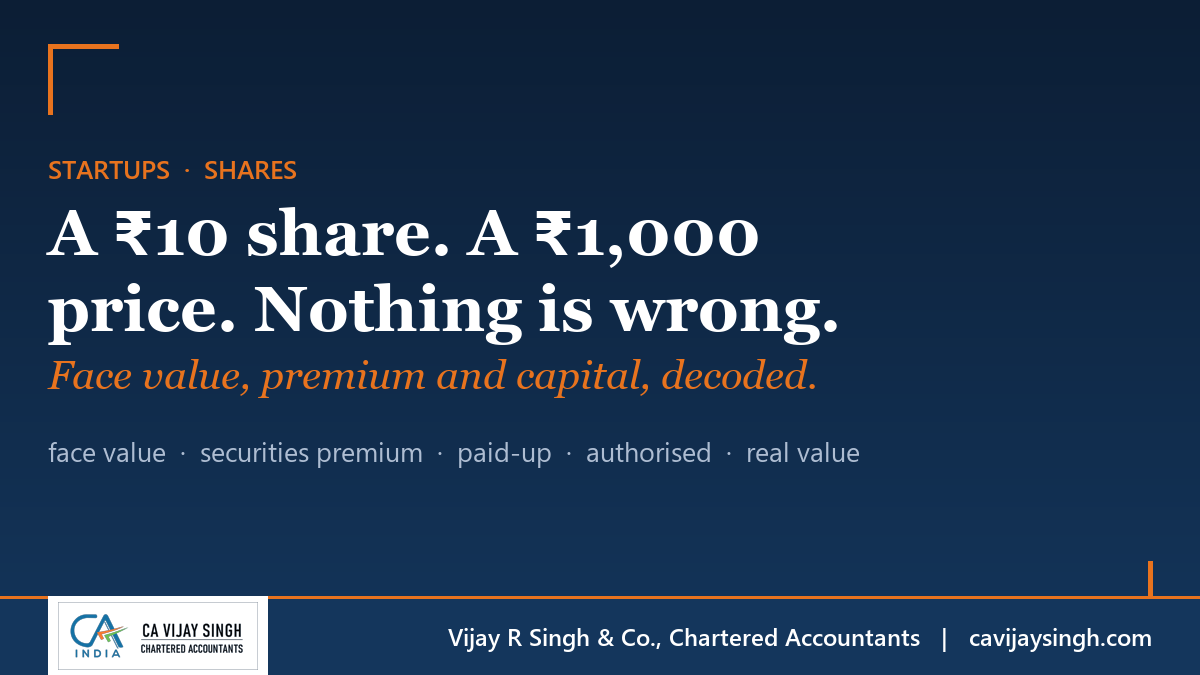
A founder called in a mild panic: “The investor paid ₹1,000 per share, but the certificate says ₹10. Did we file something wrong?” Nothing was wrong — that gap is exactly how startup investment is supposed to look. But the call captures a real problem: three numbers sit on every cap table — face value, premium, and paid-up capital — and founders routinely mix them up in the meetings where they matter most.
Face value: a label, not a worth
Face value (usually ₹10, sometimes ₹1) is simply the denomination printed on the share — a unit of account fixed in your charter documents. It says nothing about what the share is worth. Raising the face value to “look bigger” is a pointless exercise: it changes the label, not the value, and just makes future arithmetic clumsier.
Premium: what today’s value adds on top
When an investor pays ₹1,000 for a ₹10 share, the extra ₹990 is the securities premium — the market’s acknowledgement that the company is worth far more than its labels. The premium sits in a special reserve in the company’s books (Section 52, Companies Act 2013) with restricted uses; it is not income and not profit — it is investment, and it stays in the company.
Paid-up capital: the shares actually issued
“₹1 lakh capital” on your incorporation papers does not mean the company is worth ₹1 lakh. Paid-up capital is just face value × number of shares issued — the count of labels handed out so far. A company with ₹1 lakh of paid-up capital can be worth ₹100 crore; the two numbers live on different planets. (Authorised capital, its cousin, is merely the ceiling of labels you are allowed to issue — raise it when a funding round needs headroom.)
| Term | What it actually is | What it is NOT |
|---|---|---|
| Face value | The label printed on each share | Not the share’s worth |
| Premium | Amount paid above the label; sits in a restricted reserve | Not income or profit |
| Paid-up capital | Labels issued so far (face value × shares) | Not the company’s value |
| Authorised capital | Ceiling of labels you may issue | Not money anyone has paid |
| Company value | What someone will pay for a piece today | The only number that is a worth |
Why founders should care before the term sheet
Because these words appear in every SHA, every valuation discussion, and every filing after a round — and using them loosely is how founders get talked past in negotiations. Price per share, face value, premium and post-money value connect through simple arithmetic; a founder who can do that arithmetic live in the meeting negotiates from a different position than one who nods along. It is the same literacy that makes cap table and vesting decisions legible.
What to actually do
- Keep face value boring — ₹10 (or ₹1) and never think about it again.
- Back every premium with a valuation report — the price needs a defensible story the day it is set.
- Check authorised capital before a round — increase it in advance so allotment isn’t delayed.
- Spend ten minutes with your CA on your own cap table — face value, premium, paid-up, and what each share class can do.
Frequently asked questions
Is it legal to issue shares above face value?
Completely — it is the normal way startups raise money. The amount above face value is securities premium, held in a dedicated reserve under Section 52 of the Companies Act 2013. What matters is that the issue price is supported by a proper valuation report.
Is share premium taxable as income for the company?
No — premium is capital, not income, and it stays in the company in a restricted reserve. The old “angel tax”, which taxed premium above fair value in certain cases, has been abolished; see what changed when angel tax went. Pricing discipline still matters for other reasons, so keep the valuation paper.
What is the difference between authorised and paid-up capital?
Authorised capital is the maximum share capital the company is permitted to issue under its charter documents; paid-up capital is what has actually been issued and paid for. Paid-up can never exceed authorised, which is why authorised capital is increased before a large round.
Does higher paid-up capital make my company look stronger?
Not to anyone who matters. Investors, banks and acquirers look at the business and its valuation, not the count of labels issued. Deliberately inflating paid-up capital just increases stamp duty and fees for zero benefit.
Can we issue shares below face value?
As a rule, no — issuing shares at a discount to face value is prohibited for ordinary issues under the Companies Act 2013 (sweat equity being the structured exception). If the company’s value has genuinely fallen below the label, that is a conversation about restructuring, not discounting.

CA Vijay R Singh, FCA
Founder, Vijay R Singh & Co., Chartered Accountants · ICAI M.No. 153926 · FRN 136869W
Chartered Accountant for startups, NRIs and SMEs in Mumbai, in practice since 2013. More about CA Vijay →
Educational content, not tax or legal advice — share capital mechanics are governed by the Companies Act 2013 and pricing has tax and FEMA 1999 touchpoints that are fact-specific. Consult your advisor before any issue or transfer. Vijay R Singh & Co., Chartered Accountants · FRN 136869W · ICAI M.No. 153926 · Mumbai, in practice since 2013.