Company Incorporation Services in India – CA Vijay Singh

Best Business Structure for You

Why Choosing the Right Structure Matters

Your business structure is more than just a legal formality  it defines how investors view your company, the extent of your personal liability, how profits are taxed, and even how smoothly you can expand in the future. Selecting the wrong structure can lead to unnecessary compliance burdens or missed opportunities for funding.

At CA Vijay Singh & Co., we go beyond generic advice:

  • Comprehensive analysis of your business model – We study your industry, revenue plans, and risk exposure.

  • Comparison of entity options – Private Limited vs. LLP vs. OPC explained with real-world case studies.

  • Custom roadmap – Recommendations tailored to your long-term goals for fundraising, ownership, and scalability.

Explore our interactive tool below to get a quick idea of which entity fits your business. Then, watch the detailed video breakdown (LLP vs Private Limited) to understand the nuances before taking your decision.

Selecting the appropriate legal entity is crucial. Here is a comparison to guide your decision:

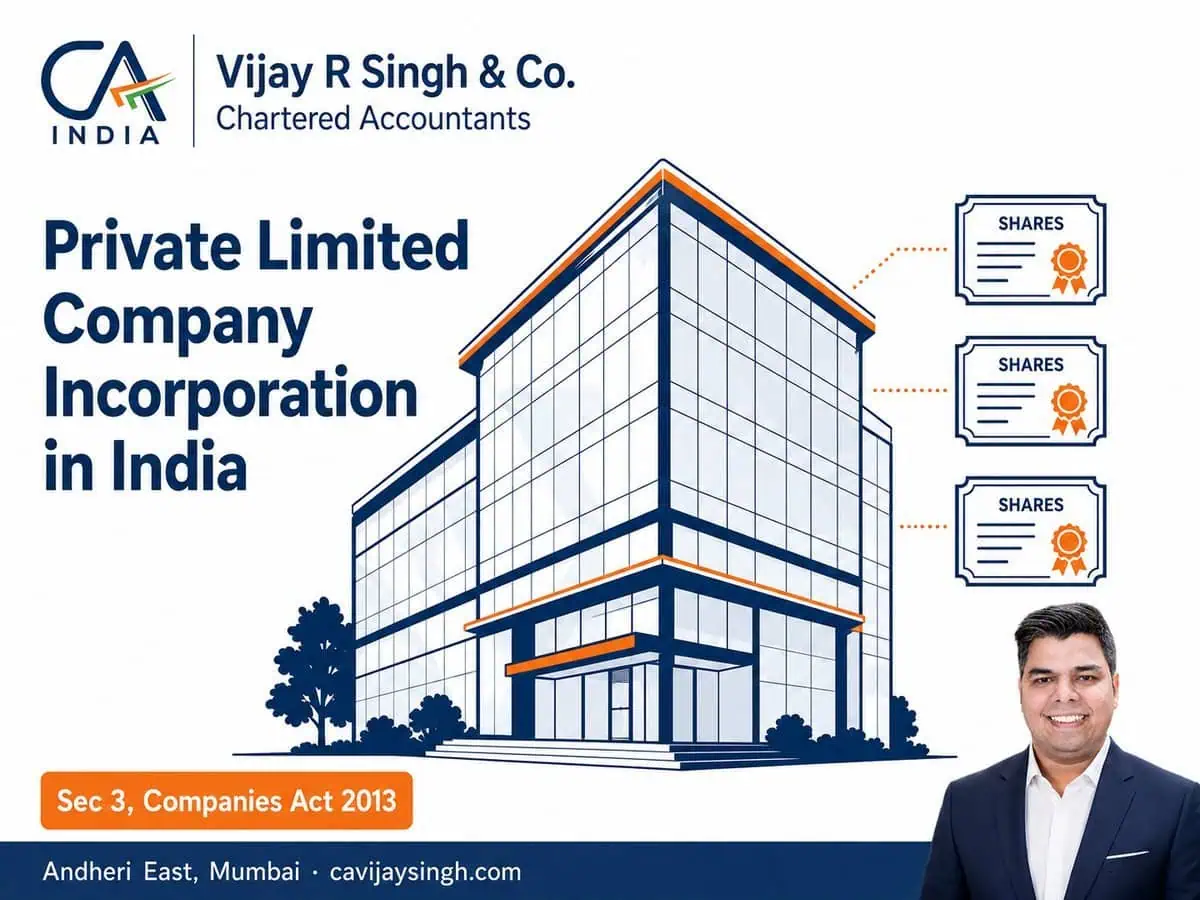
Private Limited Company (Pvt Ltd)

Best For: Startups aiming for Venture Capital funding, offering ESOPs, or needing the highest level of credibility and liability protection.

Key Advantage: Separate legal entity; the preferred structure for investors and scalability.

Limited Liability Partnership (LLP)

Best For: Professional services, consulting firms, or joint ventures seeking liability protection with fewer annual compliance requirements than a Pvt Ltd.

Key Advantage: Combines the flexibility of a partnership with the protection of a corporate structure.

One Person Company (OPC)

Best For: Solo entrepreneurs who want the benefits of a corporate entity (like limited liability) without needing a co-founder.

Key Advantage: Full ownership control with the legal status of a company.

Private Limited Company (Pvt Ltd)

Best For: Startups aiming for Venture Capital funding, offering ESOPs, or needing the highest level of credibility and liability protection.

Key Advantage: Separate legal entity; the preferred structure for investors and scalability.

Private Limited Company (Pvt Ltd)

Best For: Startups aiming for Venture Capital funding, offering ESOPs, or needing the highest level of credibility and liability protection.

Key Advantage: Separate legal entity; the preferred structure for investors and scalability.

Limited Liability Partnership (LLP)

Best For: Professional services, consulting firms, or joint ventures seeking liability protection with fewer annual compliance requirements than a Pvt Ltd.

Key Advantage: Combines the flexibility of a partnership with the protection of a corporate structure.

One Person Company (OPC)

Best For: Solo entrepreneurs who want the benefits of a corporate entity (like limited liability) without needing a co-founder.

Key Advantage: Full ownership control with the legal status of a company.

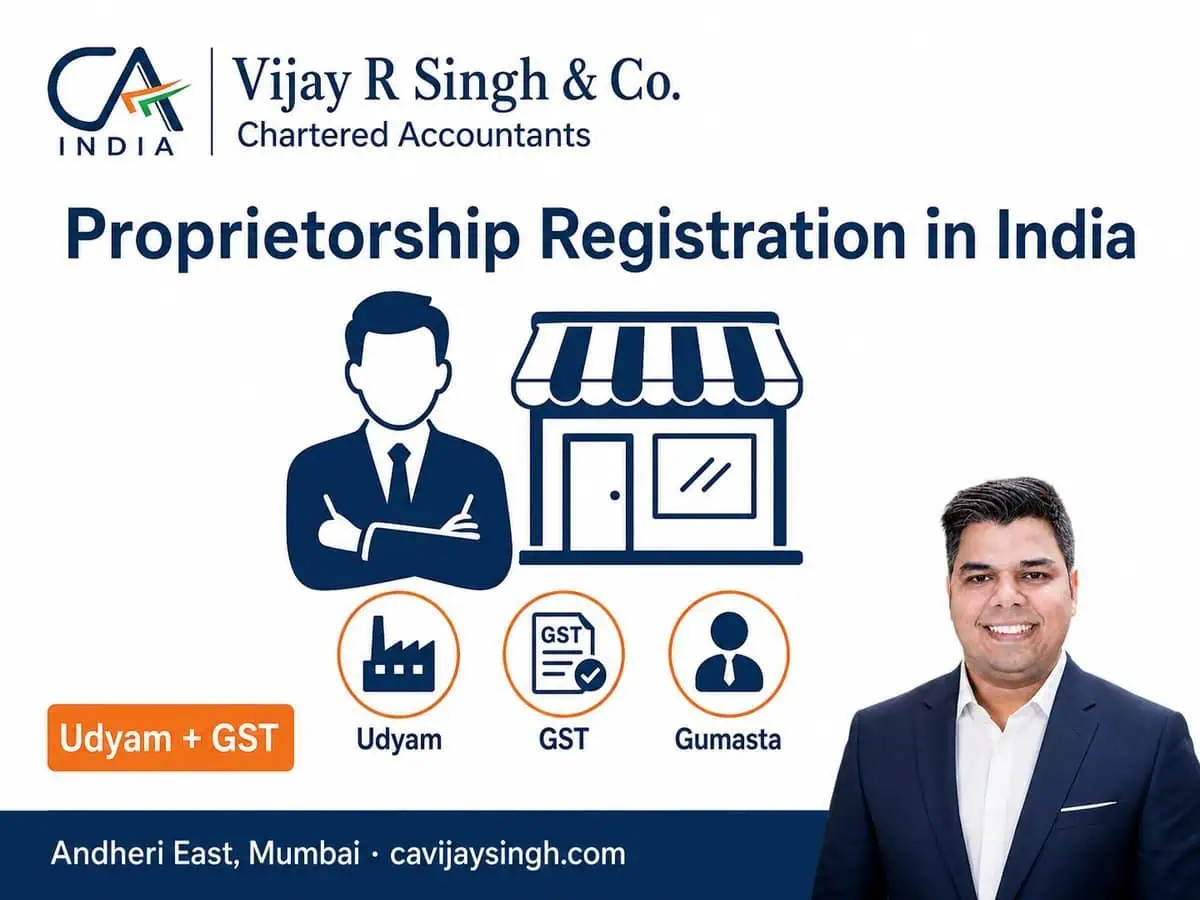
Sole Proprietorship

Best For: Freelancers, small traders, or individuals testing a business idea with minimal investment and compliance.

Key Advantage: Easiest and most cost-effective to start, but offers no personal liability protection.

The Vijay R Singh & Co. Advantage

CA-Guided Expertise: Direct consultation with experienced Chartered Accountants ensures compliance with the latest MCA regulations and advice tailored to your business goals. 100% Digital & Transparent: Our process is entirely online, efficient, and hassle-free. We offer clear pricing with no hidden fees. Comprehensive Service: We handle everything Name Reservation, DSC, DIN, MOA/AOA drafting, PAN, and TAN allotment. Beyond Incorporation: We are your long-term compliance partners, offering ongoing support for GST, accounting, auditing, and secretarial services.

Ready to Formalize Your Business?

Don’t let legal complexities slow you down. If you are unsure about the best path forward, let our experts clarify your options.

The Ultimate Guide to Startup India Registration (2025 Mumbai Edition)

Mumbai’s startup scene is buzzing, and you’re ready to make your mark. But before you scale, there’s a crucial step that separates promising ventures from recognized powerhouses: getting official startup recognition from the Government of India’s Department for Promotion of Industry and Internal Trade (DPIIT).

This guide gives you a no-nonsense, step-by-step walkthrough of the entire process.

First Off, What is DPIIT Startup Recognition?
Think of it less as a new type of company registration and more as an official badge of honour 🏅. This recognition certifies that your business is innovative, scalable, and poised for growth.

This badge is your key to unlocking a suite of powerful benefits designed to accelerate your journey from an idea to an empire.

Are You Eligible? The Official Checklist ✅

To get recognized, your business must meet ALL FIVE of these criteria.

🏢 Entity Type: You must be a registered Private Limited Company (Pvt Ltd), a Limited Liability Partnership (LLP), or a Registered Partnership Firm.

🎂 Age: Your company must be less than 10 years old from its date of incorporation.

💰 Turnover: Your annual turnover cannot have exceeded ₹100 crore in any previous financial year.

🌱 Originality: Your business must be an original entity, not one formed by splitting up or restructuring an existing company.

💡 Core Mission: You must be working on an innovative product, process, or service with high potential for creating wealth and employment.

If you ticked all five, you’re ready for the next step.

Gather Your Arsenal: Documents You’ll Need 🧰

Before you start the online application, have these files ready in PDF format.

Core Company Files

Certificate of Incorporation / Registration Certificate

Company PAN Card

Your Business Pitch

A compelling Pitch Deck or a brief document explaining the problem you solve, your innovative solution, and your business model.

Digital Presence

A link to your live website or a video that showcases your product or service.

The Path to Recognition: Your Step-by-Step Digital Journey 🚀

The government has made this process incredibly straightforward.

The Foundation (Step 0): This is non-negotiable. You must first incorporate your business as a Pvt Ltd, LLP, or Partnership Firm via the Ministry of Corporate Affairs (MCA). You cannot get “Startup Recognition” without a registered business entity.

Register on the Portal: Go to the official Startup India website and create your profile.

Fill the Application: Complete the online recognition form with your company details. The most critical section is the one where you describe your company’s innovation. Be clear, concise, and compelling.

Upload Your Documents: Attach the PDFs you prepared earlier.

Self-Certify & Submit: Review your application, self-certify that all information is correct with a simple checkbox, and hit submit. You will receive an application number instantly.

Key Takeaway: The entire process is 100% online, paperless, and has zero government fees.

The Payoff: Benefits That Fuel Your Growth 🏆
For a total effort of about 2-4 weeks (including company incorporation), here’s the incredible value you unlock:

💸 The BIG One: Tax Holiday

You can apply for a complete income tax exemption for any 3 consecutive years within your first 10 years of operation.
Note: This requires a separate, post-recognition approval from the Inter-Ministerial Board (IMB).

📄 Easy Government Tenders
Gain an edge in public procurement. You’re exempt from prior experience and turnover criteria for many government tenders.

⚖ Reduced Compliance Burden
Breathe easy. You can self-certify your compliance with 6 labour laws and 3 environmental laws for up to 5 years.

🧠 IPR Protection & Rebates
Protect your ideas for less. Get up to an 80% rebate on patent filing fees and 50% on trademark fees, plus access to a network of facilitators.

🤝 Funding & Networking
Become eligible for funding from the government’s ₹10,000 Crore Fund of Funds and gain access to exclusive startup events and networking platforms.

🚪 Fast-Track Exit
In a worst-case scenario, you can wind up the company in just 90 days, compared to the standard 180+ days.

Your Launchpad: Get Started Now

Ready to make it official? The journey to becoming a nationally recognized startup begins at the official portal.

https://www.startupindia.gov.in/

Now go build the next big thing. The ecosystem is waiting.

FAQ Section

Q1. What is the best business structure for startups in India?

The best structure depends on your goals. Most startups choose a Private Limited Company because it is investor-friendly, scalable, and offers strong liability protection. However, LLPs are popular for consulting or service firms due to lower compliance requirements, while OPCs suit solo founders.

On average, incorporating a Private Limited Company in India costs between ₹10,000 to ₹15,000, including government fees and professional charges. At CA Vijay Singh & Co., we provide transparent pricing with no hidden charges.

It depends on your business model. LLPs are cost-effective and have simpler compliance, but Private Limited Companies are preferred if you plan to raise venture capital, issue ESOPs, or expand internationally.

Yes. Foreigners and NRIs can register a 100% foreign-owned Private Limited Company in India. However, FEMA regulations apply, and compliance with RBI reporting is mandatory. Our team guides you through the entire process.

The basic documents include identity proof, address proof, passport-size photos of directors, proof of registered office address, and digital signatures. Additional documents may be needed depending on the business type.

In most cases, incorporation takes 7–10 working days if documents are in order. Startup India recognition and other registrations may take additional time.

The best structure depends on your goals. Most startups choose a Private Limited Company because it is investor-friendly, scalable, and offers strong liability protection. However, LLPs are popular for consulting or service firms due to lower compliance requirements, while OPCs suit solo founders.

On average, incorporating a Private Limited Company in India costs between ₹10,000 to ₹15,000, including government fees and professional charges. At CA Vijay Singh & Co., we provide transparent pricing with no hidden charges.

It depends on your business model. LLPs are cost-effective and have simpler compliance, but Private Limited Companies are preferred if you plan to raise venture capital, issue ESOPs, or expand internationally.

Yes. Foreigners and NRIs can register a 100% foreign-owned Private Limited Company in India. However, FEMA regulations apply, and compliance with RBI reporting is mandatory. Our team guides you through the entire process.

The basic documents include identity proof, address proof, passport-size photos of directors, proof of registered office address, and digital signatures. Additional documents may be needed depending on the business type.

In most cases, incorporation takes 7–10 working days if documents are in order. Startup India recognition and other registrations may take additional time.

Business Setup & Incorporation in India

“Pick the right structure for what you are actually building – then have it filed correctly, the first time.”

By CA Vijay R Singh, FCA

ICAI Membership No. 153926 | FRN 136869W | Practising since 2013

Quick Summary

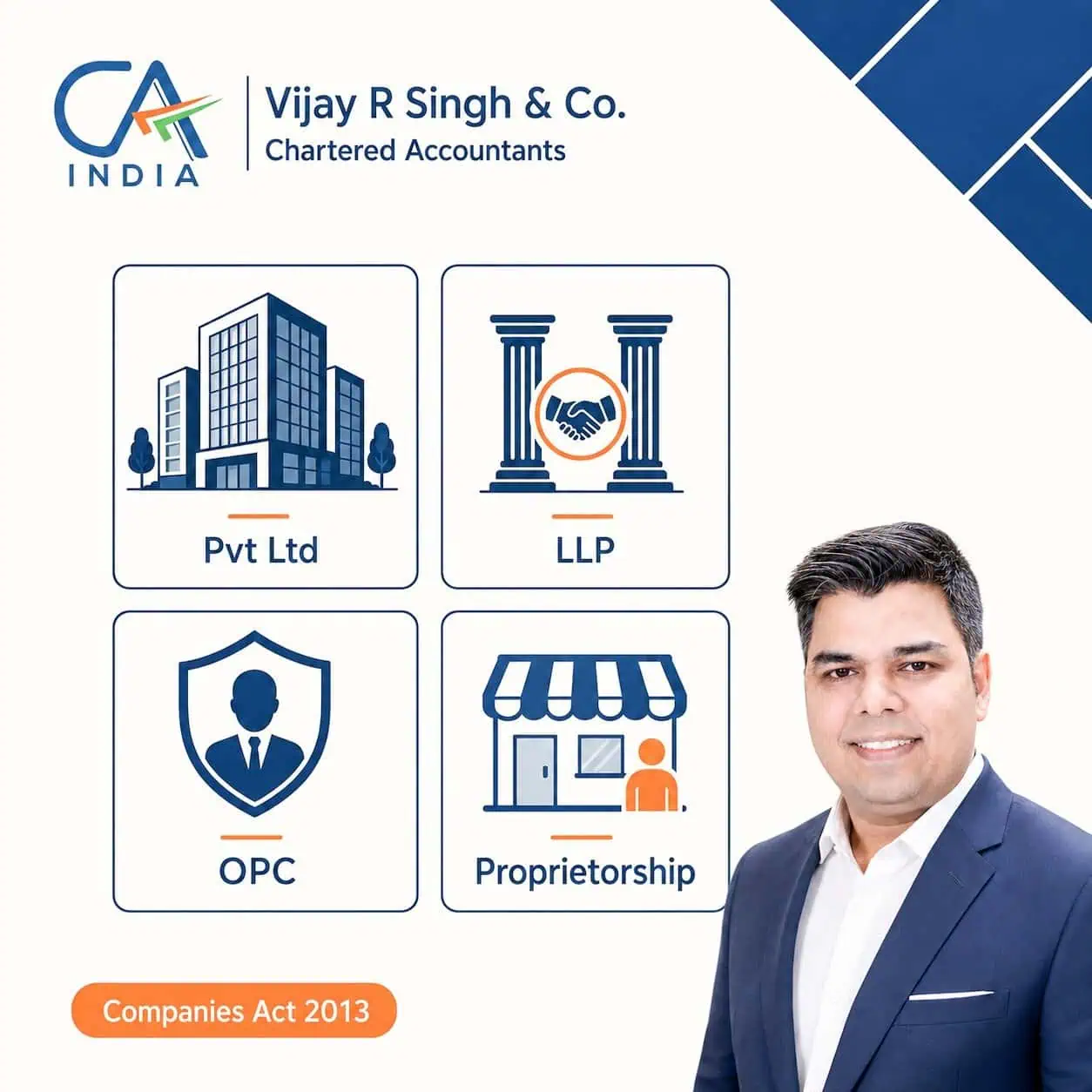
End-to-end company incorporation in India for first-time founders, returning NRIs, and foreign companies establishing Indian operations. We help you pick the right structure – Private Limited, LLP, OPC, or Proprietorship – file the incorporation with the MCA, complete PAN, TAN, GST, and bank account work, and hand over a first-year compliance calendar so the structure starts working from day one.
Strategic Fit: Is this right for you?

First-Time Founder

Indian founder starting their first company and choosing between Pvt Ltd, LLP, OPC, and Proprietorship.

Existing Proprietor Converting

Proprietorship outgrowing its structure - co-founder joining, funding round coming, liability protection needed.

NRI Founder

Non-resident Indian setting up an Indian company with FEMA-compliant capital infusion and FC-GPR support.

Foreign Subsidiary

Foreign company setting up a 100% WOS in India under the automatic FDI route.

Multi-Founder Team

Two or more founders structuring shareholding, vesting, and ESOP pool from incorporation.

Family Business

Formalising family business into LLP or Section 8 Company structure for governance and succession.

Final Deliverables Checklist

Everything you receive at the end of the engagement.

UNDERSTANDING THE STRUCTURE DECISION

Funding Plans

If you are raising from angels or VCs within 18 months – Private Limited is the default. Investors expect this structure. LLP and Proprietorship cannot take VC equity.

Founder Count

Solo founder – OPC (corporate) or Proprietorship (non-corporate). Two or more partners – LLP (no external equity) or Pvt Ltd (external equity possible).

Liability Need

Personal asset exposure matters – Pvt Ltd, LLP, and OPC all separate personal from business liability. Proprietorship does not – the proprietor and the business are the same person.

Transparent Pricing Structure

Government cost (varies by state and capital)

Engagement & Fees

We handle company and entity setup end-to-end — structure selection, name approval, drafting, and incorporation filing with post-incorporation handover — with the right structure agreed during an initial scoping call.

Fees are confirmed per engagement after the scoping call, based on the scope and complexity involved. You receive a clear, written quote before any work begins — no hidden charges.

Quoted per Engagement

The final quote depends on the scope, volume, and statutory complexity of your specific engagement.

Frequently Asked Questions

Should I start with a proprietorship and convert later?

Sometimes yes. If you are testing a service-based idea with no immediate capital, no co-founder, and turnover under Rs 40 lakh, a proprietorship lets you start invoicing in 7-10 days at near-zero cost. The conversion to Pvt Ltd or LLP later is a clean process. If a funding round is coming or you already have a co-founder, start with Pvt Ltd or LLP from day one to avoid converting twice.

Government fees and stamp duty are state-dependent and capital-dependent. Professional fees are quoted per engagement based on the structure and complexity. The cost difference between structures is real but small relative to the operating compliance load – pick the structure that fits the business, not the cheapest one to set up.

Yes, for all four structures, subject to a No Objection Certificate from the property owner.

For Private Limited, OPC, and LLP, the incorporation forms require professional certification – CA, CS, or CMA. Proprietorship does not strictly need a CA, but you will need one within the first year for ITR, GST, and book-keeping.

For Pvt Ltd and OPC – INC-20A within 180 days, auditor appointment within 30 days, first board meeting, GST filings (if registered), TDS deduction and filing, annual ROC filings, ITR. For LLP – Form 11 and Form 8 annually. For Proprietorship – ITR, GST returns (if registered), TDS (if applicable).

Yes we offer a monthly compliance retainer that picks up where the incorporation hands over. See the Tax & Compliance for Startups page for the full scope.

© 2026 Vijay R Singh & Co., Chartered Accountants | FRN 136869W | M.No. 153926 | +91 98607 23959 | info@cavijaysingh.com | Andheri East, Mumbai 400069

Book a Call