
Presumptive Taxation for Professionals in India: The Closed-List Defect
India lets many professionals pay tax on a presumed margin of their gross receipts instead of maintaining full books — a simplification meant to cut compliance cost for small practices. But the relief is tied to a closed list of “specified professions.” A professional whose field is not on that list cannot use the scheme, however small the practice. This note explains the defect, how it carries into the Income-tax Act 2025, and what a workable fix looks like. The full paper is on SSRN.
What presumptive taxation does for professionals
Under Section 44ADA of the Income-tax Act 1961, an eligible professional with gross receipts up to the prescribed limit may offer 50% of those receipts as income and is relieved from maintaining detailed books and, in many cases, from audit. For a genuinely small practice this saves real time and accountancy cost. Eligibility, however, runs through Section 44AA(1) — the list of “specified professions” (legal, medical, engineering, architectural, accountancy, technical consultancy, interior decoration, and a few fields added later by notification).
The closed-list defect
That eligibility list is closed: it admits a new field only when the Government formally notifies it. The economy has moved faster than the notifications. Many present-day independent professionals earn exactly the way a doctor or architect does, but because their field is not on the list, they are shut out of presumptive taxation altogether and pushed into full books — and, above the threshold, audit. Two professionals with similar receipts and similar work can therefore carry very different compliance burdens, purely because of which list their occupation happens to sit on.
What changes — and what doesn’t — under the Income-tax Act 2025
The Income-tax Act 2025, in force from 1 April 2026, re-codifies the regime. The closed list of “specified professions” now sits in Section 62(4). A great deal turns on that one list: it governs eligibility for the professional rate of presumptive taxation under Section 58, and the obligations to maintain books of account and to undergo tax audit under Sections 62 and 63. The structure is retained — relief and compliance both still hinge on a closed, notification-driven list — so the defect is not an artefact of old drafting; it survives the recodification. (For periods straddling 1 April 2026, both the 1961 and 2025 Acts are referenced.)
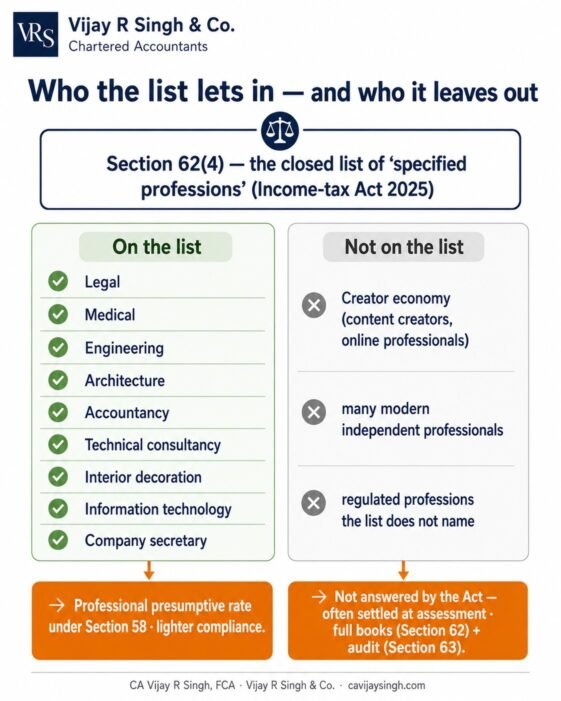
A simple illustration
Consider two professionals with comparable annual gross receipts. A doctor or lawyer is plainly a “specified profession” and can use the professional presumptive rate under Section 58. A full-time independent content creator earning similar receipts from the same kind of personal skill is not clearly on the list — so whether they qualify for presumptive taxation, and whether they must keep full books and face audit, may not be answered by the Act at all, but settled during assessment. Same economics; a different, and uncertain, compliance burden — decided by the list rather than by principle.
The reform the paper proposes
Through doctrinal analysis of the statutory text, the paper identifies five drafting defects in the specified-professions list: (1) the enumerated heads are left undefined; (2) the definition is split between the Act and delegated legislation; (3) professions are included or omitted without any stated principle; (4) heads of unequal determinacy are grouped together; and (5) there is no mechanism for the list to evolve. Their cumulative effect, the paper argues, is that whether a taxpayer carries on a “specified profession” is in many cases not answered by the Act but settled in the course of assessment — in substance delegating part of the definition of the tax base to the assessment process. The paper shows that the 2025 recodification edited the list (promoting information technology and company secretary into the bare Act) without reforming it, examines the position of regulated professions and the creator economy, and proposes that Section 62(4) be redrawn as a principled, self-updating test.
Read the full paper
The full paper — “Parliament’s Closed List: Specified Professions, Section 62(4) of the Income-tax Act, 2025, and the Unfinished Reform of Presumptive Taxation” (23 pp., 2026) — is available on SSRN: https://papers.ssrn.com/sol3/cf_dev/AbsByAuth.cfmper_id=11650028
About the author

By CA Vijay R Singh, FCA
ICAI Membership No. 153926 | FRN 136869W | Practising since 2013
CA Vijay R Singh, FCA (ICAI Membership No. 153926) is a practising Chartered Accountant in Mumbai and the founder and principal of Vijay R Singh & Co., Chartered Accountants (Firm Registration No. 136869W), in practice since 2013. His work focuses on the taxation of professionals and small practices, NRI and cross-border taxation (FEMA, DTAA), and startup structuring.
Profiles:
ORCID – https://orcid.org/0009-0004-1824-4318
Google Scholar – https://scholar.google.com/citations?user=hubBj18AAAAJ
SSRN – https://papers.ssrn.com/sol3/cf_dev/AbsByAuth.cfmper_id=11650028
LinkedIn – https://www.linkedin.com/in/cavijaysingh/
If your own position raises similar questions — eligibility for presumptive taxation, books and audit thresholds, or the 1961-to-2025 transition — you can discuss it directly with CA Vijay R Singh.