

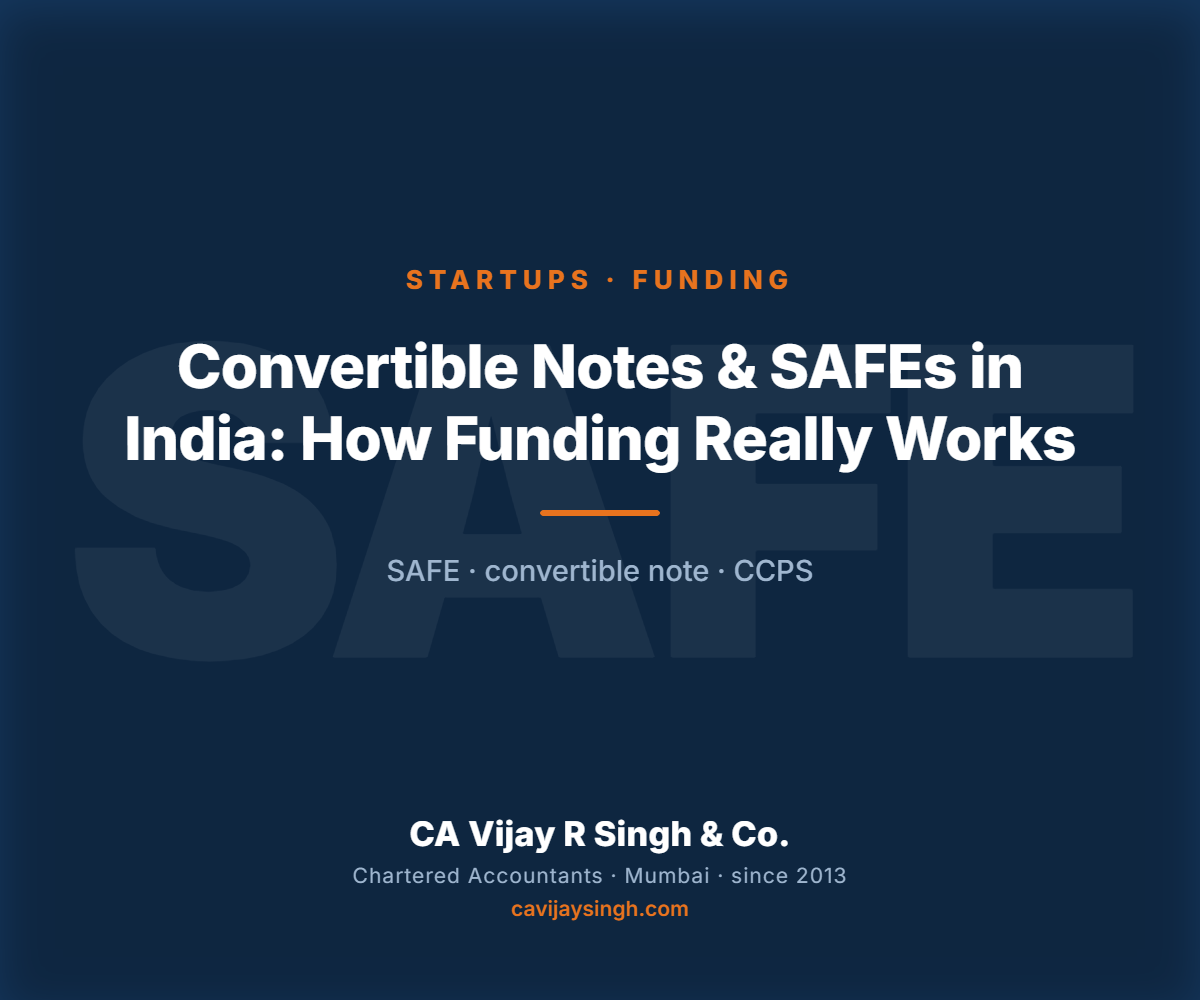
Your US-based angel sends over a SAFE to sign. Two pages, no valuation, no haggling — the founder-friendly instrument everyone in Silicon Valley uses. There’s just one problem: a standard SAFE doesn’t actually work under Indian law.
That doesn’t mean you can’t raise a quick, valuation-later seed round. It just means using the instrument that does the same job and fits Indian rules.
The short version
- A standard US-style SAFE isn’t a recognised instrument in India.
- For early rounds, Indian startups use convertible notes, CCPS or CCDs instead.
- A convertible note can only be issued by a DPIIT-recognised startup, minimum ₹25 lakh per investor, convertible within 10 years.
- CCPS is the instrument most VCs actually use.
- Whatever the front-end says, it must convert into a recognised Indian instrument — and a foreign investor triggers FEMA pricing and reporting on conversion.
01Why a plain SAFE doesn’t fly here
A SAFE (Simple Agreement for Future Equity) is a US contract: the investor gives money now for shares later, at the next round’s price, usually with a valuation cap or a discount. It works in the US because US company law accommodates it. Indian company law and FEMA don’t recognise the SAFE as a security — so a vanilla US SAFE signed for an Indian company is a contract that doesn’t map onto how shares are actually issued and reported here.
A SAFE is a great idea that doesn’t have a clean home in Indian law.
02The Indian toolkit, side by side
Three instruments do the SAFE’s job within Indian law — plus an Indian adaptation of the SAFE itself:
| Instrument | Valid in India? | Key rule / when to use |
|---|---|---|
| US SAFE | No | Not a recognised security — translate it, don’t sign it raw. |
| Convertible Note | Yes | DPIIT startups only; min ₹25 lakh/investor; convert or repay within 10 years. |
| CCPS | Yes | The VC workhorse — preference shares that must convert to equity. |
| CCD | Yes | Same idea via debentures that must convert. |
| iSAFE | Yes | Built on CCPS — gives the SAFE’s cap-or-discount feel, legally. |
Because founders wanted SAFE-like simplicity, the iSAFE was created — under the hood it’s built on CCPS, so it stays inside Indian law while giving you the quick, cap-or-discount feel of a SAFE.
03The pricing and conversion rules
04So which should you use?
- DPIIT-recognised, investor fine with debt-that-converts → a convertible note is clean and quick.
- Not DPIIT-recognised, or a fund that wants preference terms → CCPS is the standard answer.
- The investor insists on “a SAFE” → give them an iSAFE / CCPS, which delivers the same economics legally.
What you shouldn’t do is sign a raw US SAFE and assume it’ll sort itself out later. It won’t — and it’ll surface in due diligence at your next round.
05The bottom line
The SAFE is a great idea that doesn’t have a clean home in Indian law. The fix isn’t to force it; it’s to use the instrument that does the same job — a convertible note if you qualify, otherwise CCPS — with the conversion and FEMA mechanics handled properly. Get that right at the seed stage and your cap table stays clean all the way to Series A.
This article is for general information and isn’t legal or tax advice. The rules around convertible instruments and FEMA change, and your situation deserves advice specific to it.
Frequently asked questions
Are SAFE notes valid in India?
A standard US-style SAFE isn’t recognised under Indian company law or FEMA. Indian startups use convertible notes, CCPS or CCDs instead — or an iSAFE built on CCPS.
Who can issue a convertible note in India?
Only a DPIIT-recognised startup, with a minimum of ₹25 lakh per investor in a single tranche, convertible or repayable within 10 years.
What is CCPS?
Compulsorily Convertible Preference Shares — preference shares that must convert into equity on agreed terms. It’s the instrument most Indian venture rounds use.
What is an iSAFE?
An Indian adaptation of the SAFE, built on CCPS, so it stays within Indian law while keeping a SAFE’s simplicity.
Do convertible instruments need a valuation?
A price or pricing formula must be fixed at issue, and at conversion the price can’t be below fair value. For foreign investors, FEMA pricing and FC-GPR reporting apply at conversion.
Read next
Part of A Founder’s Guide to Startups in India — structure, funding, ESOPs & compliance.
Quick answers: Is a SAFE valid in India? · How convertible notes work · Angel tax on convertible notes